Welcome to Funks Grove Church
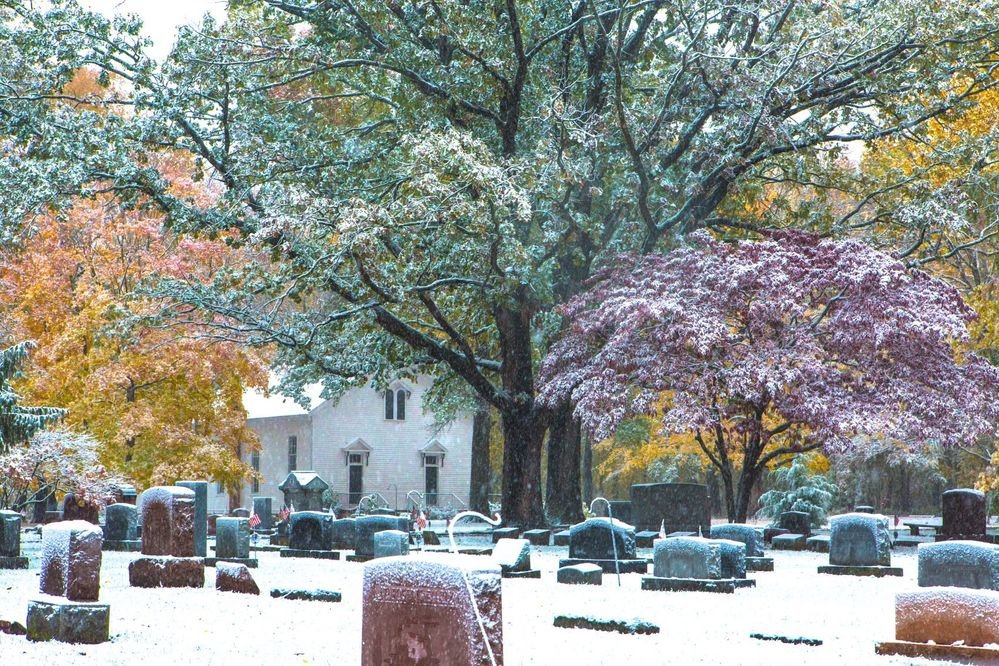
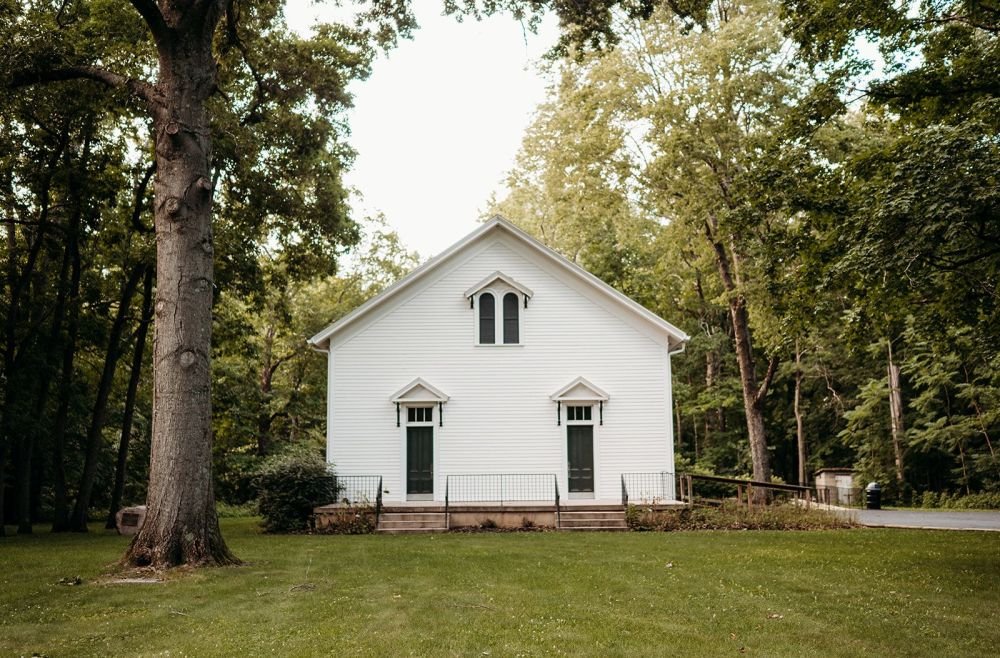
After many years of holding church services in his home and then at the school, Robert Stubblefield insisted on a real church in 1863. Erected in 1864-1865 by the Stubblefield and Funk families, this quaint country church holds tight to its roots. The church still contains the original walnut pulpit, altar rail, as well as much of the original glass. A walnut davenport made by Ben Stubblefield when he was 15 sits in place behind the pulpit. The wooden pews were carefully refinished and left in place, along with the pine partitions separating the men from the women. The original heating stoves remain in their original positions.
The interior was redecorated in 1952. Walnut cut from Funks Grove timber was used for much of the interior design. Some of this walnut had been cut and stored as early as the 1880's by George Stubblefield, Robert and Dorothy's son. (George was six months old when he arrived in Funks Grove with his family in 1824.) George's son, Thaddeus Stubblefield, added liberally to the stockpile of wood his father had started. The walnut lumber was stored in the loft of the hand-hewn log frame cabin that was the first home of Robert and his family.
Under the direction of Ben Stubblefield (Thaddeus' nephew) and Lafayette Funk, architectural changes and updates were made. The lumber was taken to a mill in Lincoln to be cut and finished, then used to panel the front and back walls and to add decorative box beams to the ceiling. Side walls were covered with cedar wood imported from Oregon. The seven-foot-high cross at the front of the church was built with light colored ash from the Grove. It is a striking contrast to the deep walnut walls. Pictures of Robert and Dorothy Stubblefield and Isaac and Cassandra Funk are displayed on the back wall. To improve the church lighting without spoiling the picturesque effect of the old wall-bracket kerosene lamps, an indirect lighting system was installed along the side walls just below the ceiling.
During the summer of 1957, an addition was added to the north end of the Church to provide men and women with indoor bathrooms, dressing rooms, and storage space.
In 2001, it was noticed that the church ceiling was sagging in the southeast corner. Upon investigation, it was discovered that the ceiling had detached from the rafters. The church underwent an extensive renovation, repairing the ceiling, rebuilding the walnut box beams, refinishing the floor, remodeling and updating the bathrooms and plumbing, cleaning the pew cushions, resealing the porch, updating the indirect lighting, landscaping, and fixing the stone foundation at the northeast corner.
In 2002, the hallway floor joist, subfloor, and hardwood floors were replaced. The front entrance doors were repainted to the original dark green color. The exterior was stripped of approximately 13 layers of paint and repainted. The east porch was rebuilt, and seamless gutters were installed.
In 2003, the pews were removed, stripped, and repainted. The walnut trim was cleaned and stained. The wainscoting and interior window frames were repainted. The original tongue-and-groove partition was yellow pine, but this was replaced with walnut cut in the 1930's and stored in the Funk Seed house.
Currently, the church is used for weddings, Christmas Eve service, and by other churches for occasional services. On August 9, 2015, a church service was held to rededicate the church and celebrate its 150th anniversary. This was the fourth rededication. Other rededications were held June 1866, August 1, 1945, and May 17, 1953.
A Little White Church
A little white church stood praying,
A little white church in the a wood
Surrounded by virgin forrest
Where a century it has stood.
A church of ten thousand spires
Rooted deep in rich prairie sod
The trees are ruggedly reverent
Reminding the passer of God.
Eager folk came on the Sabbath
To sing, to pray, to rejoice
Their songs, amens and the preaching
Gave the little white church a voice.
Now the little church is silent.
No longer do worshippers come;
Revered, quaintly neat and painted
But the little white church is dumb.
The birds sing on mid the branches,
The winds give the tree-tops a voice
The flowers bloom in the springtime
And make the woodland rejoice.
So the little white church keeps praying
That folk who grow hungry of soul
Will rise, renew its commission
Give it life, a voice, and a goal.
--Loyal Morris Thompson
- from the booklet Welcome to Funks Grove Timber